Harley has always been there for her owner Ian, through life’s ups and downs, so when the much-loved German Shepherd became seriously ill, he was terrified of losing her.
For Ian and his family, Harley is much more than a pet.
The eight-year-old German Shepherd has been part of the family for three years and quickly stole Ian’s heart. “I got her from a friend and the first time I met her she wanted to be with me,” said Ian.
With her loving nature and playful personality, Harley loves nothing more than chasing her favourite ball and spending time with Ian’s daughter and stepdaughters. Her gentle nature has touched the lives of many people around her, making her far more than just a pet to those who know her.
That’s why Ian knew something was seriously wrong when Harley suddenly stopped acting like herself.
“She was vomiting white foam, and I could tell she was in pain,” he said.
As Harley’s condition worsened, Ian became increasingly concerned.
“I was worried when Harley first became ill. I’ve been through a lot with her, and she’s been there for me the whole time.” Knowing she needed urgent help, Ian contacted Middlesborough PDSA, who advised him to take her straight down for an appointment.
On examination, the veterinary team could tell something wasn’t right. Harley’s tummy felt abnormal, so vets carried out blood tests and X-rays to find out what was causing her symptoms.
The X-rays revealed that Harley’s stomach was dangerously bloated and showed what appeared to be a foreign object inside her stomach.
Vets suspected it was causing a life-threatening blockage, so Harley was rushed straight into surgery.
Veterinary Surgeon, April Rochford, said “Harley was very poorly when she arrived at the Pet Hospital. She was lethargic, vomiting repeatedly and had a hard, bloated abdomen. Because she is a large breed dog, we were concerned she may have developed gastric dilatation-volvulus (GDV), which can quickly become life-threatening without urgent treatment.”
“The X-rays confirmed our concerns; Harley’s stomach was severely enlarged and full of gas, and we could see bone fragments inside. We knew she needed emergency surgery to give her the best chance of recovery.”
April said “during surgery, we discovered that Harley’s stomach had twisted and become dangerously distended. We were able to untwist the stomach and remove what turned out to be most of a chicken carcass, which had caused a blockage between the stomach and intestines.
“GDV is a very serious condition and unfortunately not all dogs survive it. Harley needed emergency treatment quickly, so her owner’s fast action played a huge part in her successful recovery.”
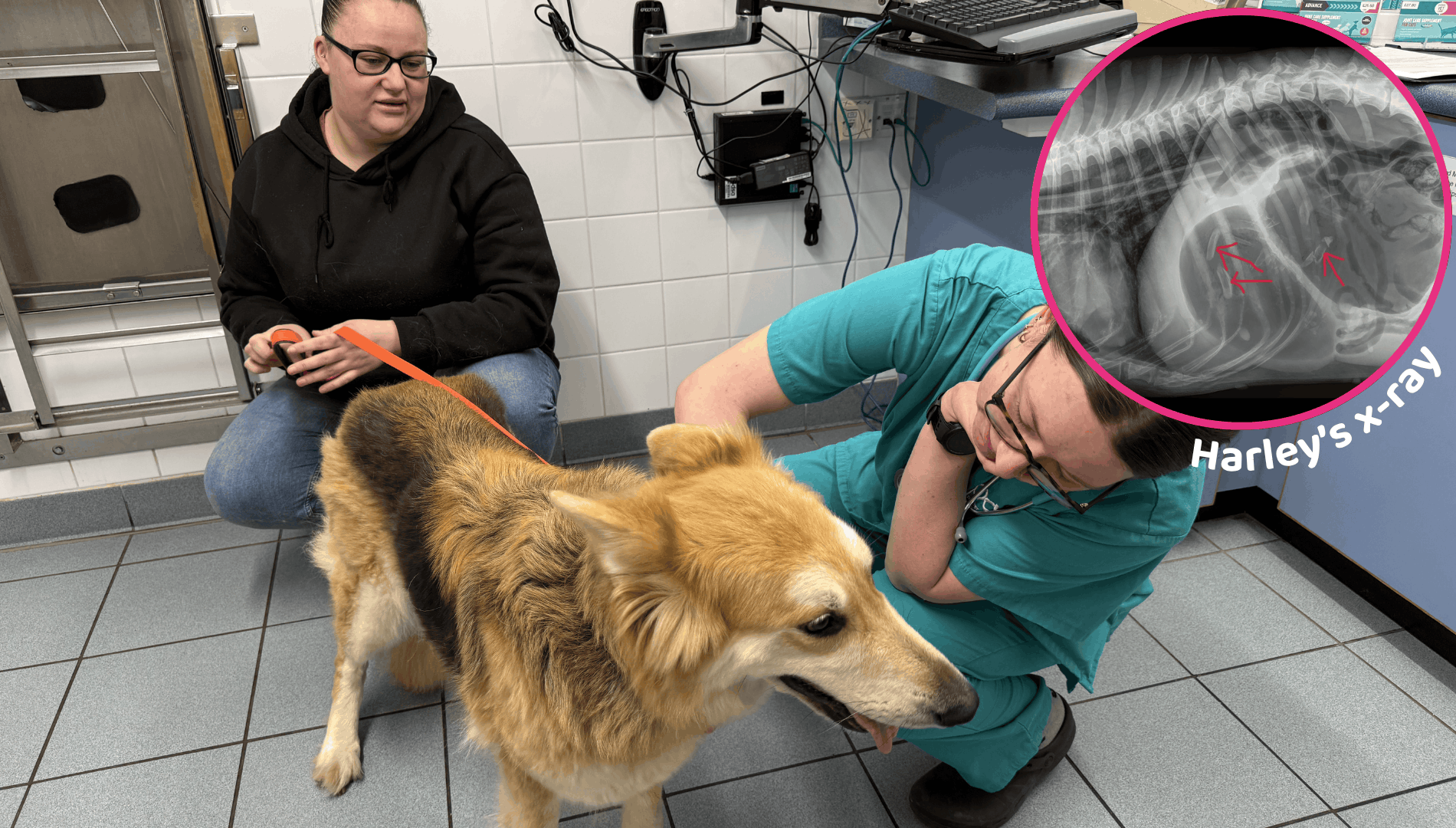
*X-ray shows a bloated stomach and the arrows point to some fragments of the chicken carcass.
As vets operated, they discovered another serious problem. Harley had a very large ovarian cyst that also needed to be removed. So, the team neutered Harley, which included removing the large cyst while she was already under anaesthetic, helping prevent further health complications in the future.
Because German Shepherds are at a higher risk of gastric dilatation-volvulus (GDV), a potentially life-threatening condition where the stomach bloats and twists, vets also carried out a complex, preventative procedure that anchors the stomach to the body wall to prevent it twisting if she gets bloated again.
Faced with the news that Harley needed multiple procedures, Ian put his trust in the veterinary team. “I said to the vet, ‘whatever needs doing, just do it. As long as she’s healthy, that’s the main thing.’”
Thankfully, Harley responded well to treatment and began her road to recovery. After returning home, she was able to rest with her family and gradually regain her strength.
Speaking about Harley’s recovery, the surgeon said “Finding the ovarian cyst was completely unexpected, so Harley ended up having three major procedures during one operation. Despite everything she had been through, she recovered brilliantly.
“A week later she came trotting back into the Pet Hospital with a wagging tail. Seeing her feeling so much better was incredibly rewarding for the whole team.”
Today, Harley is back to her happy, playful self. She’s enjoying life once again, spending time with her family and playing with her dog friends.
For Ian, seeing Harley back where she belongs means everything.
Thanks to the generosity of PDSA supporters, pets like Harley can receive the life-saving treatment they need when the unexpected happens. Every donation helps us continue caring for poorly pets and supporting the people who love them.
Total cost of Harley’s treatment (funded by PDSA): £1,483.60

PDSA is the UK’s leading veterinary charity. Through our network of over 40 Pet Hospitals and associated clinics and our Pet Care scheme, we save the lives of poorly pets who would otherwise be left untreated.
Every year, we treat over 430,000 pets. Without us, emergency cases like Harley's would be left untreated and many pets could lose their lives or be separated from families who love them.
We wouldn’t be here for dogs like Harley without your support. Please consider donating today.

Give pets like Harley a fighting chance
Pets who have been there for us during the cost of living crisis deserve somewhere to turn when they need life-saving treatment.
will save pets like Harley
Every £1 donated will help us make sure sick and injured pets get the treatment they desperately need.
Donate nowWhere to next?
Gastric Dilatation Volvulus (GDV)
Find out more about the symptoms, causes and treatments for GDV on our Pet Health Hub.
Sign up to our newsletter
Want to read more stories like Harley's, keep up with the latest pet wellbeing news, or perhaps you just want to support PDSA? Get your latest PDSA news with our Newsletter.
A little treat
Looking to pamper your pet? Why not shop some of our vet-approved products! When you buy with us, you'll help pets like Harley.