
Rabbits
Rabbit health checks: why regular vet visits matter
In 2026, we asked owners whether their rabbit had any ongoing conditions or illnesses from a list of common health problems in rabbits. Just over half (52%) reported that their rabbit did not have any of the conditions listed, significantly higher than among dog owners (40%). This may relate to the fact that health problems can be missed in rabbits.
Rabbits are prey animals and are very good at hiding signs of pain and illness until they become seriously unwell. In addition, our Report found that one in four rabbits (25%) were not currently registered with a veterinary practice, which may mean they are less likely to receive regular health checks. Regular veterinary care can help identify health problems early and support good health and welfare.
What to feed rabbits: understanding their dietary needs
Our survey found that hay and rabbit pellets were the most commonly reported main foods fed to rabbits in 2026 (80% for both), followed by fresh greens such as vegetables or herbs (77%). Almost a quarter (24%) were also fed fresh grass.
However, 13% of rabbits were reported to be fed rabbit muesli mix as one of their main food types. Muesli-style diets can encourage selective feeding and contribute to rabbit health and welfare problems, including dental disease, digestive disorders, obesity and reduced activity levels. The proportion of rabbits fed muesli mix has remained stable in recent years but was significantly lower than in 2017 (25%) and 2019 (21%).
Access to hay also remains an area of concern. Among owners who fed their rabbit hay, 82% reported providing unlimited access, the ideal for a rabbit diet, while 16% provided less than the recommended amount and 2% did not know how much they provided.
These findings suggest that many pet rabbits are not receiving diets that meet feeding recommendations, particularly in relation to adequate access to hay and the continued use of muesli-style diets. This may reflect that owners don’t know where to go for clear, accessible information about feeding rabbits, with 46% of rabbit owners reporting that there is not enough information available to help owners understand their pets’ dietary requirements.
PDSA recommends that pet rabbits have constant access to high-quality hay and/or grass (fresh or dried), ideally in unlimited amounts, alongside a handful of fresh greens and around 15g of commercial rabbit nuggets or pellets per kg of body weight each day.
The most common reason rabbit owners gave their pet treats was to provide variety (54%), significantly higher than among dog owners (25%) and cat owners (32%). Almost half (44%) said they gave treats because it makes their pet happy, while 34% said they did so because it makes them feel happy.
To help prevent rabbits from becoming overweight or underweight, we recommend weighing them regularly and monitoring their body shape. Owners should seek advice from a veterinary professional if they have concerns about their rabbit’s weight.
Rabbit housing and exercise: the welfare benefits of giving rabbits space to move freely
In 2026, 51% of pet rabbits were reported to live predominantly indoors and 49% predominantly outdoors. This was not significantly different from 2025, but represents a significant change from 2018 and 2020, when 39% lived predominantly indoors and 61% predominantly outdoors.
Just over half of rabbit owners (56%) said their rabbit could move freely between their hutch and run. While 36% said their rabbit had to be let in or out or physically moved between the two. These findings were not significantly different from 2024. Restricting rabbits' ability to move freely between their living and exercising areas can limit their opportunities to exercise and express natural behaviours when they choose.
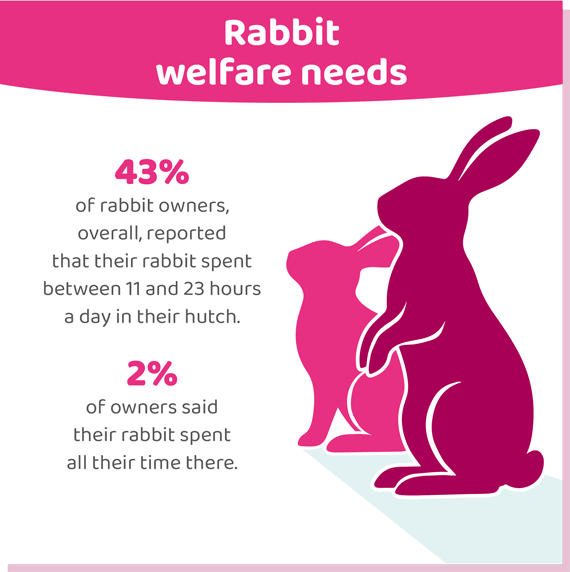
Time spent confined to a hutch also remains a concern. Overall, 43% of rabbit owners reported that their rabbit spent between 11 and 23 hours a day in their hutch, while a further 2% said their rabbit spent all their time there. This was more common among predominantly outdoor rabbits, with 62% spending between 11 and 23 hours a day in their hutch, compared with 25% of predominantly indoor rabbits.
Rabbits can live indoors or outdoors, but they need a large living space to run, jump, stretch and play, as well as to express natural behaviours such as digging and foraging. Knowing how much space rabbits need is an important part of providing them suitable housing. PDSA recommends that rabbits have constant access to a run measuring at least 3m x 2m x 1m, alongside a shelter or a hutch where they can hide or sleep. Indoor rabbits should also have daily opportunities to access natural daylight outdoors. Providing sufficient space and opportunities for exercise and natural behaviours is important for rabbits’ health and welfare.
Keeping rabbits in hutches with limited opportunities to exercise can increase stress and affect activity levels, highlighting the importance of providing sufficient space and daily opportunities to exercise outside their hutch¹.
Rabbit social needs: do rabbits need to be in pairs?
In 2026, 44% of rabbits were reported to live with at least one other rabbit, with 20% living with at least one rabbit of the same sex and 24% with at least one of a different sex. This has not changed significantly since 2017. However, 43% of rabbits were reported to live on their own. Although this is significantly lower than in 2017 (56%) and 2018 (54%), there has been no significant change since 2019. These findings highlight the importance of understanding rabbits’ social needs when considering their housing and companionship.
Among owners whose rabbit lived alone, the most common reason was that they had previously owned more than one rabbit, but the others had passed away, and they did not want to replace them (48%). Other reasons included not wanting more than one rabbit (21%) and their rabbit not getting along with other rabbits (18%). For owners considering whether rabbits should be kept in pairs, compatibility and the individual needs of each rabbit are important considerations.
Rabbits are highly social animals. PDSA recommends keeping rabbits in compatible pairs or groups to help prevent loneliness and stress, which could lead to problematic behaviour. Introducing a new rabbit to an existing rabbit or group requires patience, and the bonding process should be carried out gradually before rabbits share a living space, but it is essential for their health and welfare that they are not kept alone.
Key Takeaways
Overall, the findings highlight positive trends in some aspects of rabbit welfare, including providing the right diet and access to an exercise area. However, too many rabbits are still living without the companionship of other rabbits, despite their highly social nature. Challenges also remain around rabbit healthcare, hay and muesli feeding, time spent in hutches and social companionship. Supporting owners with clear, practical information about feeding rabbits, rabbit housing and rabbit health could help more rabbits experience a good quality of life.

Footnotes
¹Low base sample for this statistic; see methodology for more information.